

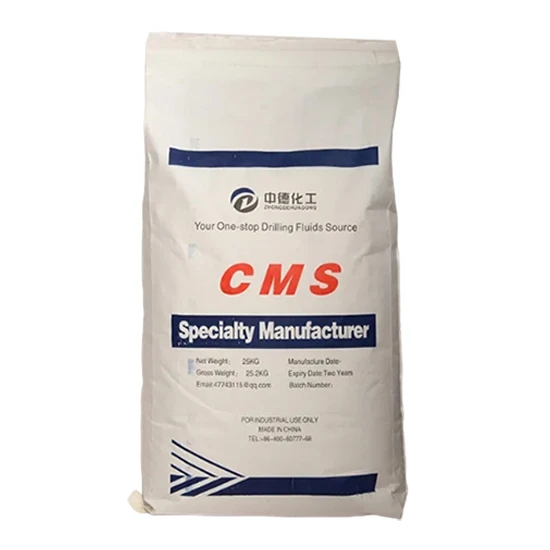
Carboxymethyl starch is an anionic starch ether with the chemical formula of [c10h19o8na]n, white or yellow powder, and an electrolyte soluble in cold water. It is a kind of modified starch and belongs to ether starch. It is a water-soluble anionic polymer compound. It is tasteless, non-toxic, not easy to mildew, and soluble in water when the degree of substitution is greater than 0.2. CMS has stable aqueous solution and excellent performance, with the functions of bonding, thickening, water retention, emulsification, suspension and dispersion. As a mud stabilizer and water retaining agent during oil well operation, CMS can reduce water loss and improve the coalescence stability of clay particles in drilling fluid. CMS has little influence on the plastic viscosity of the mud, and has a great influence on the power and shear force. It is conducive to carrying drilling cuttings. Especially when drilling the salt gypsum layer, CMS can stabilize the drilling fluid, reduce the loss and prevent the collapse of the well wall. It is especially suitable for saline alkali wells with high salinity and high pH value.
Enhanced Viscosity
Carboxymethyl starch CMS has excellent thickening and stabilizing abilities, allowing it to enhance the viscosity and texture of the final product. It provides a smooth and uniform consistency to the product without altering its original flavor or taste.
Improved Stability
Carboxymethyl starch CMS is known for its excellent stability, which makes it ideal for a wide range of food items. Due to its high water-holding capacity, it retains moisture for a longer period of time, which helps prevent spoilage and extends the shelf life of the product.
Versatility
Carboxymethyl starch CMS provides versatility to formulations as it can be used in a variety of products such as sauces, condiments, soups, desserts, and beverages. It also provides formulation flexibility as it is compatible with other ingredients, making it easier to create customized products to meet the needs of consumers.
Cost-effective
Carboxymethyl starch CMS is a cost-effective solution as it helps to reduce production costs and increase product yield. It requires less usage than other traditional thickeners, further reducing overall costs.
Safe & Natural
Another key advantage of using carboxymethyl starch CMS as a thickener is that it is a safe and natural alternative to synthetic thickeners. It is non-toxic and does not pose any threat to human health when consumed in moderation. It is also biodegradable and eco-friendly, which makes it a top choice for sustainable manufacturing.
-
![Sodium Carboxymethyl Starch]() Sodium Carboxymethyl StarchCMS can form a uniform and continuous film on the surface of the object with good adhesion and water retention.This makes CMS widely used in food, cosmetics, paper coating and other fields.read more
Sodium Carboxymethyl StarchCMS can form a uniform and continuous film on the surface of the object with good adhesion and water retention.This makes CMS widely used in food, cosmetics, paper coating and other fields.read more -
![Fluid Loss Reducer Carboxymethyl Starch]() Fluid Loss Reducer Carboxymethyl StarchSodium carboxymethyl starch, also known as carboxymethyl starch, is an anionic starch ether with the chemical formula of [c10h19o8na]n, white or yellow powder, and an electrolyte soluble in coldread more
Fluid Loss Reducer Carboxymethyl StarchSodium carboxymethyl starch, also known as carboxymethyl starch, is an anionic starch ether with the chemical formula of [c10h19o8na]n, white or yellow powder, and an electrolyte soluble in coldread more -
![Carboxymethyl Starch for Thermal Sublimation in Paper Making]() Carboxymethyl Starch for Thermal Sublimation in Paper MakingThe raw material of CMS is starch, which has a wide source and low price. CMS used in printing and dyeing as the carrier paste of dyes and dyeing auxiliaries has the advantages of good compatibilityread more
Carboxymethyl Starch for Thermal Sublimation in Paper MakingThe raw material of CMS is starch, which has a wide source and low price. CMS used in printing and dyeing as the carrier paste of dyes and dyeing auxiliaries has the advantages of good compatibilityread more -
![Sodium Carboxymethyl Starch As Thickener]() Sodium Carboxymethyl Starch As ThickenerSodium carboxymethyl starch as thickener 1. Enhanced viscosity: Sodium carboxymethyl starch has excellent thickening and stabilizing abilities, allowing it to enhance the viscosity and texture of theread more
Sodium Carboxymethyl Starch As ThickenerSodium carboxymethyl starch as thickener 1. Enhanced viscosity: Sodium carboxymethyl starch has excellent thickening and stabilizing abilities, allowing it to enhance the viscosity and texture of theread more -
![Cms Modified Starch]() Cms Modified StarchRice and flour products: Used as a thickener and stabilizer to improve the taste and texture of rice and flour products.Dairy products: Used as a gelling agent, stabilizer, and thickener toread more
Cms Modified StarchRice and flour products: Used as a thickener and stabilizer to improve the taste and texture of rice and flour products.Dairy products: Used as a gelling agent, stabilizer, and thickener toread more -
![CMS Coating Additives]() CMS Coating AdditivesCMS coating additives have a good thickening effect and can significantly increase the consistency and viscosity of the coating, helping to improve the fluidity and coating performance of the coating.read more
CMS Coating AdditivesCMS coating additives have a good thickening effect and can significantly increase the consistency and viscosity of the coating, helping to improve the fluidity and coating performance of the coating.read more


Why Choose Us
Our Factory
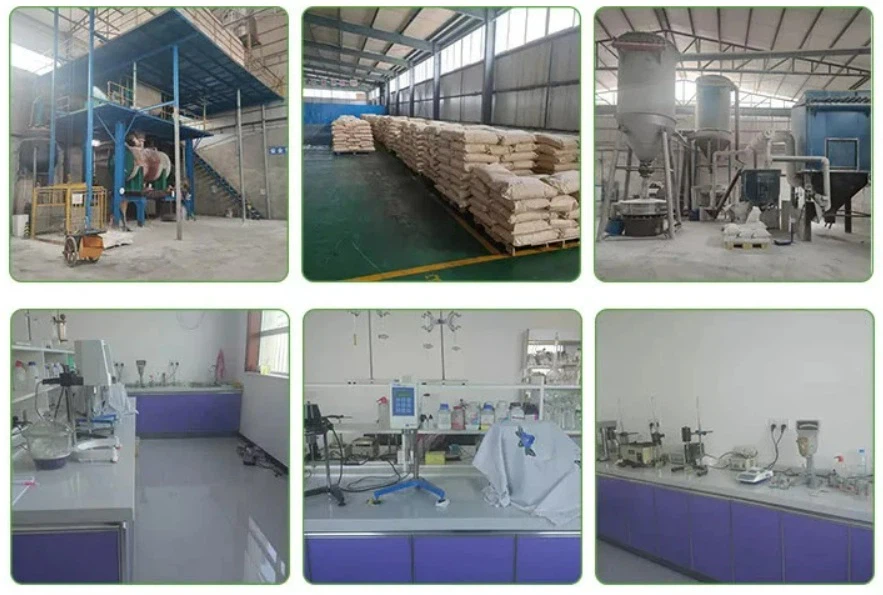
Wen'an Zhongde Chemical Co., Ltd. Founded in January 2010, it is located in the south of Beijing, the capital of China, 150 kilometers west of Tianjin Xingang. The company has advanced production equipment, the most mature production technology and modern standardized testing equipment, and testing methods meet international standards. Our products have passed the ISO9001: 2008 quality system certification, and the product quality has reached the international leading level.
Our Product
Carboxymethyl cellulose (CMC-HV, CMC-LV), polyanionic cellulose (PAC-LV, PAC-R, PAC-HV), hydroxypropyl methyl cellulose (HPMC), polyacrylamide (PAM, CPAM, APAM, NPAM),Sodium polyacrylate, carboxymethyl starch (CMS), high-temperature resistant starch for oil drilling, xanthan gum, shale inhibitor, sulfonated asphalt powder, anti sloughing agent white asphalt, plugging agent while drilling, guar gum Lubricants and detergents for drilling fluids, coating agents for drilling fluids.
Application & Market
Oil drilling construction wastewater treatment food textile printing and dyeing heat transfer.Nigeria, the United States, Japan, Russia, Türkiye, France, Pakistan, India... They come to our company for inspection and guidance.
Service Purpose
1. Fast, decisive, accurate, thoughtful and thorough
2. Service objective: Service quality to win customer satisfaction
3. Service efficiency: Solve product doubts and problems for customers in the first time.
1)Carboxymethyl starch
Carboxymethyl starch (CMS) is a kind of carboxymethyl etherification of denatured starch, it is tasteless, non-toxic, not easy to mold, easily soluble in water.It can be used in different foods, such as thickening, suspension, emulsification, stability, shape preservation, film-forming, swelling, fresh-keeping, acid resistance and health care, etc. Its performance is better than carboxymethyl cellulose (CMC), which is the best product to replace CMC.Food grade carboxymethyl starch sodium is widely used in milk, beverages, frozen food, fast food, cakes, syrup and other products.In addition, CMS is physiologically inert and has no calorific value, so foods with a low calorific value can be used to achieve the desired results.
2) Pharmaceutical grade carboxymethyl starch
Carboxymethyl starch (CMS) is widely used in medicine.In terms of pharmaceutical preparations, CMS can replace gelatin as the raw material for making capsules, tablets and icing.It has strong water absorption and expansibility, and can bubble up quickly in cold water, and after absorbing water, the particle expands and does not dissolve, does not form a colloid solution, does not hinder the water to continue to infiltrate and affect the further disintegration of the tablet, so it can be used as an effective disintegrating agent and excipient for insoluble drugs and soluble drug tablets.
3) Paper grade carboxymethyl starch
Carboxymethyl starch (CMS) is a modified starch etherified by carboxymethyl. Its performance is better than that of carboxymethyl cellulose (CMC), and it is the best product to replace CMC.CMS is widely used in paper making.Add in the filler as a stabilizer, play a role of thickening and bonding, make the paper bright gloss, improve the printing performance of paper, enhance the toughness and wear resistance of paper.Used as additive in pulp to improve retention and filtration effect.Also used for paper surface sizing, can significantly improve the dry strength and wet strength of paper, oil resistance, ink absorption and water resistance.In the use of adhesive coating can improve the production and use of paper performance.
4) Construction industrial grade carboxymethyl starch
Carboxymethyl starch (CMS) is a modified starch etherified by carboxymethyl. Its performance is better than that of carboxymethyl cellulose (CMC), and it is the best product to replace CMC.The solution has good thickening, stability, water retention, film formation, suspension effect.Easy to use, safe and environmental protection.It has been widely used in building materials industry.In putty powder, latex paint as a thickening and water-retaining agent;Used as suspending agent, stabilizer, film forming agent in coating, with emulsification, thickening, anti-deposition and other functions.Made of cement powder used in cement plastering mortar, cement insulation anti-crack mortar, ceramic tile binder, wall waterproof putty, and other products related to cement.
5) Ceramic industrial grade carboxymethyl starch
Carboxymethyl starch (CMS) is a modified starch etherified by carboxymethyl. Its performance is better than that of carboxymethyl cellulose (CMC), and it is the best product to replace CMC.CMS is used as excipient, plasticizer and reinforcing agent for billet in ceramic industry.It can increase the binding force of billet, make the billet easy to form, increase the flexure strength and effectively reduce the breakage rate of the billet.It can also make the water in the billet evaporate evenly to prevent dry cracking.Add to the glaze slurry as a stabilizer and binder, can enhance the glaze bonding, make the glaze in a dispersed state, improve the surface tension of the glaze, increase the smoothness of the glaze, reduce the phenomenon of pinhole after baking.
6) Daily chemical industrial-grade carboxymethyl starch
Carboxymethyl starch (CMS) is a modified starch etherified by carboxymethyl. Its performance is better than that of carboxymethyl cellulose (CMC), and it is the best product to replace CMC.CMS has chelating, ion exchange, polycation flocculation and other functions, and can be used as a stabilizer, fiber finishing agent and stain carrier in detergent formulation.Its descaling effect is obviously better than CMC, and its pollution diffusion ability is excellent, especially for hydrophobic synthetic fiber fabric, its anti-fouling reprecipitation effect is excellent.In the cosmetic industry, CMS is used for the manufacture of anti-acne medicines and skin cleansers as a gel to fix water or absorb water and retain water.In toothpaste, CMS can form a three-dimensional polymeric network structure, which can ensure the storage stability of paste in the tube and prolong the shelf life.Improve paste uniformity and surface finish;Reduce paste transport power.CMS is biodegradable, safe and environmentally friendly.
7) Petroleum industrial grade sodium carboxymethyl starch
Sodium carboxymethyl starch (CMS) is a modified starch etherified by carboxymethyl. Its performance is better than that of carboxymethyl cellulose (CMC), and it is the best product to replace CMC.The aqueous solution of CMS is stable and has excellent properties, such as bonding, thickening, water retention, emulsification, suspension and dispersion.CMS can be used as mud stabilizer and water retaining agent to reduce water loss and improve the coalestion stability of clay particles in drilling fluid.CMS has little effect on the plastic viscosity of the mud, and great effect on the dynamic force and shear force. It helps to carry cuttings, especially when drilling salt and paste zones, to stabilize the drilling fluid, reduce loss and prevent wall collapse.Especially suitable for high salinity, high pH value of saline-alkali Wells.
8) Printing and dyeing industrial grade sodium carboxymethyl starch
Carboxymethyl starch (CMS) is a modified starch etherified by carboxymethyl. Its performance is better than that of carboxymethyl cellulose (CMC), and it is the best product to replace CMC.The aqueous solution of CMS is stable and has excellent properties, such as bonding, thickening, water retention, emulsification, suspension and dispersion.The raw material of CMS is starch, which has wide sources and low price.CMS is used as the carrier paste of dye and auxiliary for printing and dyeing, which has good compatibility and stability.Dyeing paste prepared with CMS also has good permeability, especially for deep and transparent fabric embossing, which can quickly print patterns according to the pattern and significantly improve the brilliance of printing.In addition, CMS can be dissolved in cold water, easy to use.
Sodium carboxymethyl starch (CMS or SCMS) is a starch ether derivative derived from starch. It is soluble in water at room temperature and forms a transparent to light milky and viscous solution.
CMS is an important modified starch with unique properties due to the presence of negatively charged functional group (CH2COO-). The introduction of carboxymethyl groups interrupts the ordered structure of native starch and intervenes with the re-association of gelatinized starch. This modification yields starch with decreased gelatinization temperature, increased solubility and improved storage stability.
CMS is chemically processed carbohydrate typically derived from native starch viz. Maize, potato, tapioca & rice.
These sodium carboxy methyl starch and solution are alkaline in nature and have the capacity to replace sodium car-boxy methyl cellulose in fields like textile sizing and printing, corrugated paper, paper sizing, oil well drilling, water based distemper, oil bound distemper, electrodes, ceramics, pesticides, foundry, adhesives and others.
CMS has a wide range of applications in industries, mostly used for purposes of thickening, stabilization, water preserving, etc. In pharmaceutical industry, CMS, also known as sodium starch glycolate, is commonly used as disintegrate. It is also used in textile industry as thickening agent in textile printing paste and as sizing agent especially for hydrophilic yarn.
Another closed related material is carboxymethyl cellulose (CMC), which has been used intensively in similar industries. However, CMS not only has many advantages over CMC, but comes with a much lower price tag. Therefore, CMS is poising to replace CMC in many of industrial applications.
CMS are widely used in oil well drilling, textile, paper & corrugated board, detergent, welding electrodes, food, pharmaceutical, pesticides, cosmetic, toothpaste, paint, mining and ceramic industries.
Carboxymethyl Starch CMS as a Reducing and Capping Agent
The hydrothermal method is a cost-effective and eco-friendly route for preparing various nanomaterials. It can use a capping agent, such as a polysaccharide, to govern and define the nanoparticle morphology. Elemental selenium nanostructures (spheres and rods) were synthesized and stabilized using a tailor-made carboxymethyl starch (CMS, degree of substitution = 0.3) under hydrothermal conditions. CMS is particularly convenient because it acts simultaneously as the capping and reducing agent, as verified by several analytical techniques, while the reaction relies entirely on green solvents. When submersed into the water, the subsequent particle release was confirmed by dynamic light scattering (DLS), promising great potential for use in bio-three-dimensional printing and other biomedical applications.
Polysaccharides are promising candidates for various fields, including material science, medicine and biotechnology, due to their biodegradability, renewability and versatility. They consist of amylose and amylopectin chains. Starch is poorly soluble in water at room temperature due to the strong hydrogen bonds of hydroxyl groups, limiting its applications in food, cosmetics, medicine, absorbents and adhesives. However, it could be chemically modified due to the three active hydroxyl positions at C2, C3 and C6. Generally, this reaction is performed in a heterogeneous medium (ethanol/water, isopropyl alcohol/water, benzene/water). The polar aprotic solvent is required for efficient etherification. DS is controlled by factors such as solvent type, NaOH and SMCA concentration, temperature and reaction time. Isopropyl alcohol aqueous solution was previously identified as the most effective solvent for CMS production, giving the best DS. The solubility in water appears already at DS of 0.1. Isopropyl alcohol/water mixture is also convenient for removing unreacted impurities from CMS.
CMS is particularly convenient because it acts simultaneously as the capping and reducing agent. Used CMS with a DS of 0.3 as a reducing and stabilizing agent to investigate the hydrothermal process in more detail. It explored the effect of processing parameters, such as reaction time, temperature and reagent concentration, on the nanoparticle size and morphology. The formation of selenium nanostructures was monitored via colour change (UV-visible (UV-VIS) spectroscopy), dynamic light scattering (DLS), scanning and transmission electron microscopy (SEM and TEM), Fourier transform Infrared spectroscopy (FTIR), X-ray diffraction (XRD) and X-ray photoelectron spectroscopy (XPS). Particular emphasis was put on anisotropic Se nanorods for their potential use in biomedical applications. On top of that, we also included an application case by embedding the Se nanoparticles into a three-dimensional-printed 2-hydroxyethyl methacrylate (HEMA) hydrogel carrier.
Synthesis Process of Carboxymethyl Starch CMS

Carboxymethyl starch was prepared using sodium monochloroacetate, where 1 g (6 mmol) of potato starch was dispersed in 100 ml of the round bottom flask containing 50 ml of isopropyl alcohol-water mixture (9 : 1). The mixture was treated with 1 ml 10% NaOH at room temperature (RT) for 1 h to deprotonate the alcohol groups present in the monomeric units of starch (scheme 1a). The mixture was stirred for up to 5 h at RT, followed by adding a sodium monochloroacetate solution (2.096 g/18 mmol in 5 ml of distilled water) and stirring for 2 h at 50℃. After the reaction, a white solid was collected, dried at 50℃ for 14 h, and neutralized by 0.4 ml of 6 M HCl for 2 h at RT. Several filtrations with an acetone-water mixture were conducted to purify the product .
The obtained solids were weighed and used to grow selenium nanostructures using the hydrothermal technique. Initially, 0.1 g (1%) of carboxymethyl starch (DS = 0.3, pH 5–6) and 0.1 g (1%) of Na2SeO3 were dissolved in 10 ml of distilled water and placed into a Teflon-lined stainless steel autoclave. The reaction was performed at 160℃ for 14, 7 or 3 h (scheme 1b). It was then cooled to room temperature, and the solid content was separated by centrifuging and washed with ethanol. Different Se ion concentrations were obtained by varying the concentration of sodium selenite (1%, 0.5% and 0.25%).
Product Parameter(Specification) of Carboxymethyl Starch
|
Catalog |
BBC-CMS-1 |
BBC-CMS-2 |
BBC-CMS-3 |
BBC-CMS-4 |
|
Appearance |
White to off-white powder |
|||
|
PH |
5.5-7.5 |
3.0-5.0 |
5.5-7.5 |
5.5-7.5 |
|
NaCl |
≤6.0% |
≤6.0% |
≤1.0% |
≤6.0% |
|
Loss on Drying |
≤10.0% |
≤10.0% |
≤7.0% |
≤10.0% |
|
Na |
2.8-4.2% |
2.0-3.4% |
2.8-5.0% |
2.0-4.0% |
|
Starch |
Potato starch |
Potato starch |
Potato starch |
Corn starch |
Our Factory
Wen'an Zhongde Chemical Co., Ltd. Founded in January 2010, it is located in the south of Beijing, the capital of China, 150 kilometers west of Tianjin Xingang. The company has advanced production equipment, the most mature production technology and modern standardized testing equipment, and testing methods meet international standards. Our products have passed the ISO9001: 2008 quality system certification, and the product quality has reached the international leading level.


FAQ
We're professional carboxymethyl starch cms manufacturers and suppliers in China, specialized in providing high quality customized service. We warmly welcome you to buy high-grade carboxymethyl starch cms in stock here from our factory.
textile abrasion resistance agent, textile printing auxiliary, plastics dispersant